

| Score | Rounds Won | Total Rounds |
|---|---|---|
| 0 | 0 | 0 |


 Settings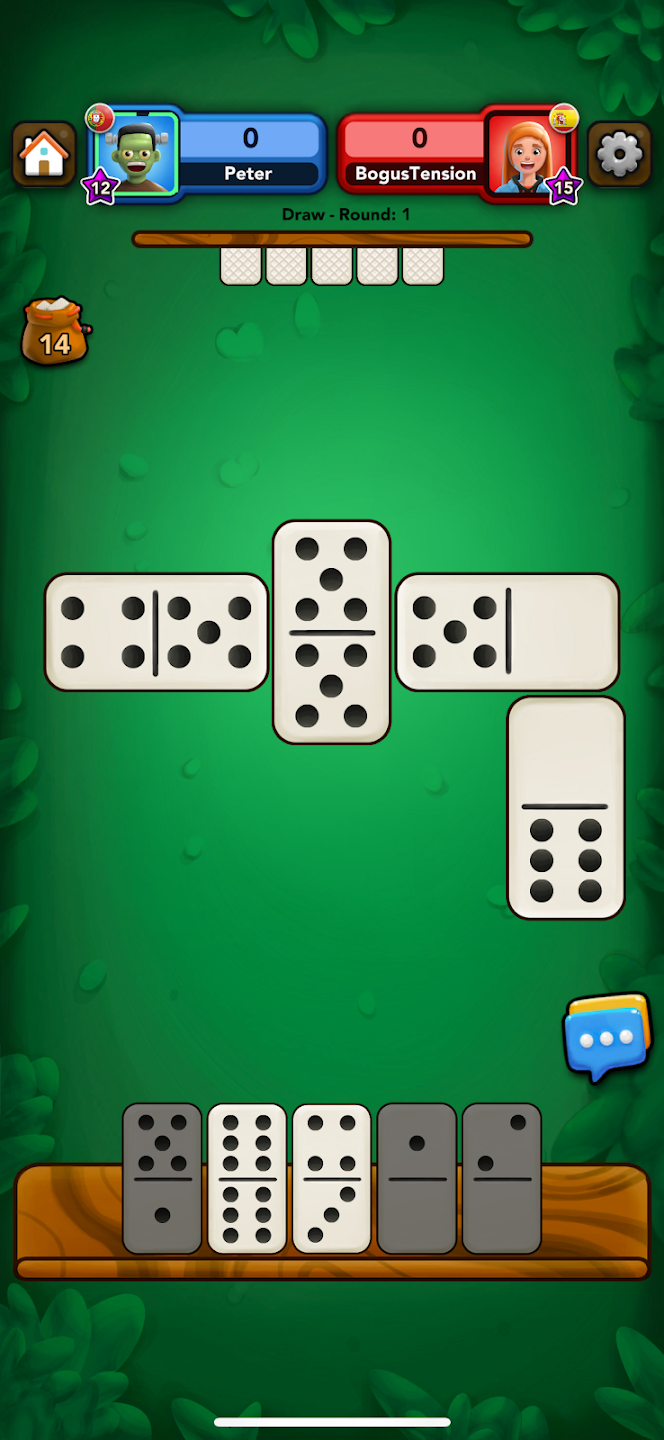
Get the Full Dominoes Experience!
Play smoother, enjoy app-only features, and keep every match close at hand.
Download AppChickenfoot Dominoes
Chickenfoot Dominoes is a fun and strategic dominoes game where players try to get rid of their tiles while keeping their final score as low as possible. The game gets its name from the special “chicken foot” shape that appears when three matching dominoes are played from one side of a double tile.
Easy to learn but full of tactical choices, Chickenfoot is a great game for players who enjoy classic dominoes with an extra twist. Every double can change the flow of the round, forcing players to complete the chicken foot before anyone can play elsewhere on the board.
Whether you are new to dominoes or already enjoy games like Draw Dominoes, Block Dominoes, or Mexican Train, Chickenfoot offers a lively mix of planning, blocking, and quick decision-making.
What Is Chickenfoot Dominoes?
Chickenfoot, also known as Chicken Foot or Chickie Dominoes, is a dominoes game from the “trains” or layout-building family of domino games. It is usually played with a double-nine or double-twelve domino set, depending on the number of players and the preferred game length.
The main goal is simple: play as many dominoes as possible before the round ends. At the end of each round, players count the pips left in their hand, and the player with the lowest total score after all rounds wins.
What makes Chickenfoot different from many other domino games is the rule for doubles. When a double is played, it must be completed with three matching tiles, creating the shape of a chicken foot before normal play can continue.
The Origins of Chickenfoot
Chickenfoot appears to have originated in Texas or Mexico, according to Pagat’s domino game reference. The game is closely related to Maltese Cross, another domino layout game that uses doubles and branching lines of play.
Some sources describe Chickenfoot as a more recent dominoes game that became popular with families and casual players because it is easy to teach, works well with groups, and creates a more dynamic table layout than traditional straight-line domino games. Today, it is often played with double-nine or double-twelve sets and is especially popular as a social dominoes game.
How to Play Chickenfoot Dominoes
Chickenfoot is played over several rounds. In many versions, each round begins with a different starting double, moving downward from the highest double in the set to the double-blank.
1. Set Up the Game
All dominoes are shuffled face down. Each player draws a hand of dominoes, and the remaining tiles form the draw pile, often called the chicken yard or boneyard.
The first round usually starts with the highest double in the set. For example, in a double-nine game, the first round begins with the double-nine, then the next round begins with the double-eight, and so on until the double-blank round.
2. Start from the Opening Double
The starting double is placed in the center of the layout. Players must first play matching tiles from this opening double before the rest of the board opens up.
If a player cannot play a matching tile, they draw from the chicken yard. If the drawn tile can be played, they play it immediately; otherwise, they pass.
3. Match Open Ends
Once the opening double has been completed according to the rules being used, players can play on any open end by matching the number of pips. As in traditional dominoes, a tile can only be placed when one end matches the open number on the layout.
If a player cannot make a move, they draw one tile from the chicken yard. If they still cannot play, their turn ends.
4. Complete the Chicken Foot
Whenever a player places a double, that double creates a chicken foot. The next three plays must be made on that double, using tiles that match the number on the double.
These three matching tiles form the “toes” of the chicken foot. No other part of the layout can be played until the chicken foot is complete.
5. End the Round
A round ends when one player plays their last domino or when no player can make a legal move. Each player then counts the total number of pips left in their hand, and that total is added to their score.
The game continues through the planned rounds. When all rounds have been played, the player with the lowest total score wins.
Chickenfoot Scoring
In Chickenfoot, lower scores are better. At the end of each round, every player adds up the pips on the dominoes left in their hand, and those points are added to their running total.
For example, if you end a round holding a 6-4 tile, a 3-2 tile, and a blank-5 tile, your score for that round is 20 points. The fewer tiles you keep, especially high-value tiles, the better your final score will be.
Some versions use special scoring rules, such as counting the double-blank as 50 points. This is a common optional rule, so players should check the rules before starting a game.
Tips and Strategies to Win
Play high-value tiles early:
Try to get rid of tiles with many pips before the round ends. Since your score is based on the tiles left in your hand, holding high-value dominoes can be costly.
Watch the doubles:
Doubles are powerful because they force all players to complete a chicken foot before playing elsewhere. Use them carefully, especially when you think other players may not have the matching number.
Keep flexible tiles:
Tiles with numbers that are already common on the board can give you more options later. A flexible hand makes it easier to avoid drawing from the chicken yard.
Pay attention to passed turns:
If another player passes, they may not have a specific number. This can help you decide which ends to open, block, or avoid.
Do not wait too long to play risky tiles:
If you hold a double or a high-value tile that may become hard to play later, look for a safe chance to use it before the board becomes blocked.
Think about timing:
Sometimes playing a double can slow down your opponents. Other times, it can help them get rid of tiles. The best move depends on the numbers in your hand and the open ends on the board.
Why Play Chickenfoot Online?
Playing Chickenfoot online makes it easy to enjoy this social dominoes game anytime. You do not need to shuffle tiles, count pieces, or manage scoring manually.
Online Chickenfoot also helps new players learn faster by showing legal moves, tracking turns, and making the chicken foot rule easier to follow. This makes the game more accessible while keeping the same strategic depth that makes Chickenfoot fun.
Whether you want a relaxed game or a competitive challenge, Chickenfoot is a great choice for players who enjoy classic dominoes with a fresh and playful twist.
FAQ
Is Chickenfoot easy to learn?
Yes. Chickenfoot is easy to learn because it uses the basic dominoes rule of matching numbers, but adds one important twist: doubles must be completed with three matching tiles before play can continue elsewhere.
How many players can play Chickenfoot?
Chickenfoot can be played by small or large groups, and some rule sets allow anywhere from 2 to 12 players depending on the domino set used.
What domino set do you need for Chickenfoot?
Chickenfoot is commonly played with a double-nine or double-twelve set.
How do you win Chickenfoot?
You win Chickenfoot by having the lowest total score after all rounds are completed. Players score points based on the pips left in their hand at the end of each round.
Why is it called Chickenfoot?
The game is called Chickenfoot because, when a double is played, three matching tiles are placed from it in a shape that looks like a chicken’s foot.
Blog
How to Play Dominoes: Rules, Setup, Scoring and Tips for Beginners
Learning how to play dominoes is simple once you understand the basic idea: place tiles so that matching numbers touch, try to get rid of your tiles before your opponent, and pay attention to the poi…

Draw Dominoes vs Block Dominoes: What’s the Difference?
Draw Dominoes and Block Dominoes are two of the most classic ways to play dominoes. They look very similar at first: players take turns placing tiles so that matching numbers touch on the open ends o…

Dominoes App
by Appgeneration Software